Exhibition Excellence 3: Sensible Sales

Selling at trade shows and exhibitions uses a number of skills including probing, active listening, staying on message and persuading.

  • Probe  – to get the client to tell you what his real needs are
  • Listen –  to understand what he is looking for
  • Stay on message – to make sure he understand the real benefits you offer
  • Persuade – Deal with questions naturally but convincingly

Here are some of the ways to manage those essential selling conversations.

“Let me show you some of the benefits we offer.”

“Would you like me to demonstrate/explain this………… for you?”

“It will (only) take about 5/10 minutes.”

“This product/product name is very successful and I’d like to explain why.”

“What would you say is the biggest challenge you’re facing?”

“How have you addressed that issue in the past?”

“How have you been dealing with challenge of ………?”

Listen, then follow up: “That’s interesting. This is what we have done for other customers…”

“You’ve seen the demo/presentation etc. Which features  could help you in your business?”

“What feature DIDN’T you hear about that might be something you’d be interested in?”

“What is your timeline for buying this  type of product/solution/offering?”

Exhibition Excellence 2: Who are you Speaking to?

One of your main challenges on a booth is managing your time. The reason you are there is to market your company or its products or services efficiently. You also want to find out what your visitors’ needs are and make sure you give them what they need.

All of this means that you must find out who they are, what they need from you and how you can best help them – given your and their time constraints. This is the reason for the Qualifying step which is an essential part of all sales conversations. Here’s some of the language you may use to do that.

What field are you involved in?

Which company do you represent?

(look at nametag)

I see you work for ……………… Which country/division/department is that?

What kinds of things are you looking for at this show?

Great show so far. What have you seen that you’ve really liked?

Exhibition Excellence 1: Stop them to Start Chatting

Language to start-up a conversation with show attendees.

Visitors to your booth are all potential leads or industry contacts. You need a way to start the short, focused conversations at trade shows and exhibitions that are the reason you are there.

Here are some ideas of the things that you can say to start talking to your booth visitors in a natural, friendly way.


Good Morning/Afternoon/Hello/Hi

Thank you for stopping by.

How are you enjoying the show?

Is this your first ( name of show) ?

Are you aware of our ………… products?

Can I interest you in…………………….

You seem to be interested in our product/name of product/this.

Am I right ?

Would you like some information about…………..?

Have you seen our new……..?

Can I help you with some information about ………………..?


How to: Be A Great Boothman

BOOTHMANSHIP CHECKLIST

Meeting people at exhibitions or trade shows on your company booth is a fantastic opportunity to be in contact with customers and others.

You are the company for booth visitors. Exhibition visitors will remember the booth staff’s performance, actions and interaction which then becomes part of your brand

BODY LANGUAGE
OPEN & WELCOMING
POSTURE
FACIAL EXPRESSION
SALESMANSHIP         
ENTHUSIASM
PERSUASIVENESS
LISTENING SKILLS
ON MESSAGE
CLOSES SALE
COMMUNICATION STYLE
CONVERSATION MANAGEMENT
SERVICE ORIENTED SPEECH
MATCHING STYLE
CROSSCULTURAL TUNING
TASK – RELATIONSHIP
DIRECTNESS
RESPECT FOR STATUS

Service with Humility

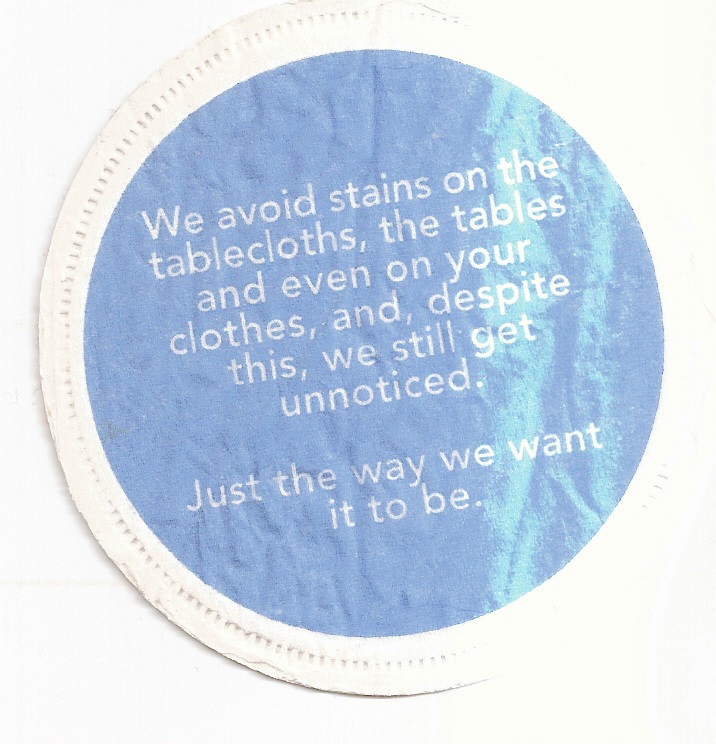
Here is a little disposable paper coaster that has no great ambitions other than to serve. It is not exactly representative of the service level that people are willing to give these days.  Neither should it be. The world has changed and the giving of service is a least partially dependent on how reasonable the client is.  Cheers!

Connecting With People – 4.74 degrees of separation?

The news from Facebook and the University of Milan research is that the famous “six degrees of separation” is now down to 4.47 or even less.
That is fine on the internet where connections are obvious but what does that mean for real life?

We believe it is only by talking to people that you can find out about those connections. This is  a good reason for more small talk – call it “connecting talk”.

Here are our guidelines for great small talk that leads to bigger things.

1. Before you meet new people come up with 2 or 3 three things to talk about as well as 3 general questions that will get others talking. Try to remember things about the people you have met before.
2. Be the first to say “Hello.” If you’re not sure the other person will remember you, offer your name first to make things smoother. For example, “Dan? David Green — good to see you again.”
3. Make an extra effort to remember names.
4. Watch your body language. People who look ill at ease make others uncomfortable. Act confident and comfortable, even when you’re not.
5. Get the other person talking by leading with a statement regarding the event or location and then asking a related open-ended question. For example, “Attendance looks higher than last year, how long have you been coming to these conferences?”
6. Stay focused on your conversational partner by actively listening and giving feedback. Maintain eye contact. Never glance around the room while they are talking to you. To be seen looking for someone   “better “ to talk to is very insulting.
7. Stay away from negative or controversial topics .
8. Have something interesting to contribute. Keep up an interest in (non-controversial) news and start conversations based on that.   You could start with
“What do you think of …?”       “Have you heard …?”      ”What is your view on …?”
9. Before joining another group or entering into a conversation that’s already in progress, observe and listen. You don’t want to interrupt the dynamic or butt in.
10. Do not tell long-winded stories or give a lot of detail in casual conversation.
11. Have a few exit lines ready so that you can both gracefully move on.
For example, “I need to check in with a colleague over there,” or “ Well, enjoy the evening” or  you can offer to refresh their drink.


You Never Stop Selling – Service & Social Media

This great article from Forbes makes the point that in the new world of social media your customers remain buyers, all the time.

“Customer” is an artificial label for counting and segregating buyers that have purchased your product.  The notion of “customer lock-in” is, in today’s world, a myth. Customers don’t stop evaluating their purchases or their vendors just because they bought. It’s actually the opposite; buyers are always buying even when they’ve just bought”.

Social media can help to find out what the buyers are saying and feeling.

http://www.forbes.com/sites/christinecrandell/2011/10/08/the-gold-in-social-customer-service/